- 작성일 2026.04.01
- 작성자 고려대학교 세종캠퍼스
- 조회수 1
Cryo-3D printing expected to enable clinical applications including large-area bone defect treatment and maxillofacial reconstruction
Korea University Sejong Campus has announced that a joint research team, composed of the Department of Biotechnology and Bioinformatics and the Daegu-Gyeongbuk Medical Innovation Foundation (K-MEDI hub), has developed a cryo-3D printing-based bone regeneration scaffold. The scaffold utilizes bioactive particles derived from human teeth to simultaneously regenerate bone and blood vessels.
This research presents a new therapeutic strategy to overcome the limitations of existing bone graft materials by experimentally proving the "osteo-angiogenic" effect, which induces bone regeneration and vascularization concurrently.
The developed scaffold promotes both osteocyte differentiation and the formation of endothelial cell networks. It is expected to be applicable not only for treating large-area bone defects but also for skull defects, maxillofacial reconstruction, and various applications in dental and orthopedic surgery. Notably, it has garnered attention as a next-generation bone regeneration platform due to its potential to improve long-term stability—a common issue in traditional bone grafts caused by insufficient vascularization.
Critical-sized bone defects resulting from trauma, tumor resection, or congenital defects are considered intractable conditions as they are nearly impossible to heal naturally. Existing graft materials often focus solely on either structural support or bone formation. Without sufficient vascularization, the stability and maturation of newly formed bone tissue remain limited.
To address this, the research team focused on human teeth (dentin) typically discarded after extraction. Teeth contain low-crystallinity bio-apatite and collagen similar to bone, and act as a biological signaling source containing various growth factors such as BMP, TGF-β, and VEGF, which can simultaneously induce osteogenesis and angiogenesis.
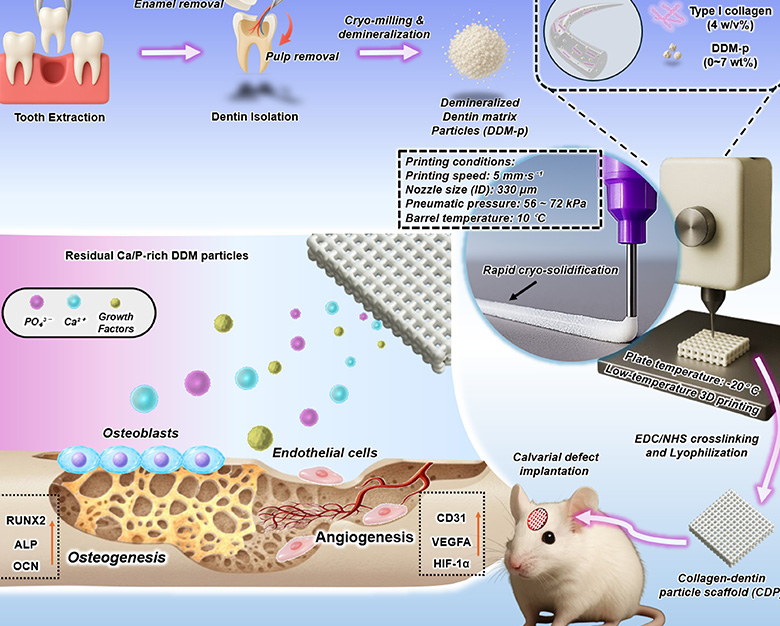
The team manufactured micron-sized dentin-derived bioactive particles through decellularization, partial demineralization, and cryogenic grinding processes. These were then mixed with collagen hydrogel to produce a lattice-shaped scaffold using cryo-printing (low-temperature 3D printing). This process allows for precise control over pore structure and mechanical properties while preserving heat-sensitive biological signals.
Experimental results showed that the scaffold containing tooth-derived bioactive particles outperformed traditional nano-hydroxyapatite-based scaffolds in osteocyte differentiation, endothelial cell network formation, and calcium/phosphate ion release. Specifically, in a rat calvarial large-area defect model, the scaffold demonstrated the highest bone density, bone volume ratio, and neovascular density, clearly confirming the simultaneous regeneration of bone and blood vessels.
Professor Hyungjin Lee of the Department of Biotechnology and Bioinformatics stated, "While existing bone graft materials focused on either structural support or bone formation, this study is significant in that it presents a platform that induces both bone regeneration and vascularization using tooth-derived biological signals. We expect this to develop into a regenerative medicine technology with high clinical applicability."
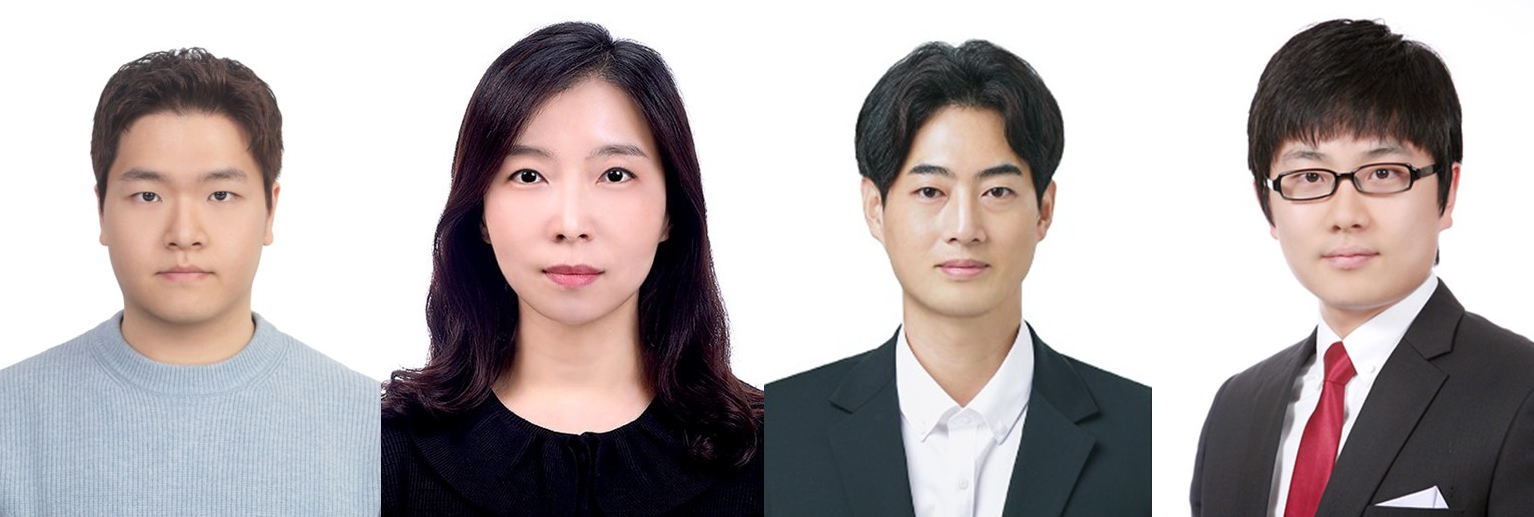
The research findings were published online on January 31, 2026, in Materials Today Bio (IF 10.2), a prestigious international journal in materials science and biomaterials. Gyuho Jeon, an undergraduate researcher from the Department of Biotechnology and Bioinformatics at Korea University Sejong Campus, and Dr. Minjung Park from K-MEDI hub participated as joint first authors. Professor Hyungjin Lee (Korea University Sejong Campus) and Dr. Myunggu Yeo (K-MEDI hub) served as corresponding authors.
The paper is titled: "Cryo-printed collagen scaffolds reinforced with dentin-derived bioactive particles promote osteo-angiogenic bone regeneration."
Notably, joint first author Jeon began participating in industry-university-academic projects at the Regenerative Bioengineering Laboratory during his junior year. He developed the fundamental experiments and core ideas of this study through those projects, for which he previously received a Grand Prize.
The continued follow-up research led to this publication in an international journal. This case is being recognized as a representative example proving that undergraduate students can produce world-class research achievements, highlighting the success of the research-centered education pursued by Korea University Sejong Campus.
This research was supported by Korea University research funds, the Sejong RISE Center’s Regional Innovation System Education (RISE) program (2025-RISE-08-001) funded by the Ministry of Education and Sejong City, and research grants (RS-2025-16064070) from the Korea Institute for Advancement of Technology (KIAT) under the Ministry of Trade, Industry and Energy.